

Understanding How to Properly Document Your Traffic Accident
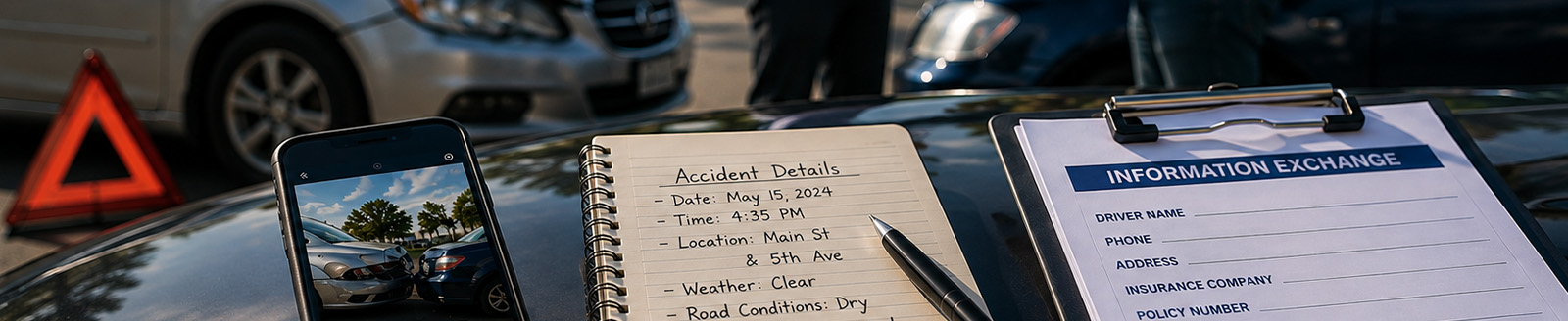
If you are involved in a traffic accident in California, you might be surprised when responding law enforcement officers hand both drivers an “Information Exchange” card and leave without writing a formal police report. This is a standard and practical procedure for busy departments. When a collision appears to involve only property damage, officers frequently treat it as a civil matter between motorists so they can remain available for urgent emergency calls.
While an information exchange card is a helpful starting point, having an official report is always the preferred way to ensure accurate documentation for your insurance company. Overworked adjusters rely heavily on neutral third-party accounts, and without a formal report, resolving a claim can take significantly longer as insurers work to verify the details of the event. At Edzant Price LLP, we frequently see how a missing police report can complicate an otherwise straightforward insurance claim.
Recently our firm represented a client involved in a very heavy collision. Officers did show up to the scene, but because no one was transported away by an ambulance, they facilitated a quick information exchange and left without writing a formal report. The officers did not write down any bystander witness information, and no one formally documented our client’s complaints of pain at the scene.
Even though liability for the crash was entirely clear and eventually accepted by the at fault carrier, the insurance company initially used this lack of documentation to attack our client’s credibility. The insurance company argued that our client was not genuinely injured, completely ignoring the fact that family members took them to the emergency room that same evening when the adrenaline wore off. We fought back and ultimately secured justice for our client, but this case highlights exactly how insurance companies exploit these procedural gaps.
If you find yourself in this situation, you can respectfully request a formal report without disrupting the officer’s demanding schedule:
- Communicate your physical status clearly: If you are experiencing any symptoms like neck stiffness, back pain or dizziness, let the officer know. Documenting physical symptoms often shifts the department protocol toward filing a formal report.
- Acknowledge their time constraints: Approach the interaction with a sincerely appreciative attitude regarding their workload. Clearly state that a formal report is needed to ensure accurate documentation for insurance tracking.
- Request a dispatch log number: If the officer is simply unable to stay, politely ask for a CAD (Computer-Aided Dispatch) incident number. This takes just a moment for the officer and creates a reliable, unalterable digital footprint showing that law enforcement responded to the scene.
In the event officers must leave without generating a full report, you can take proactive steps to preserve evidence. If safe and appropriate, take clear photos of all vehicle positioning, all vehicle damage, license plates, and road conditions. Before leaving, document the name and contact information of any voluntary on-scene witnesses. You can then visit the responding agency’s local station or website to file a standard citizen’s counter report.
Navigating the aftermath of a collision can be overwhelming, but you do not have to handle it alone. Contact Edzant Price LLP for a confidential, no-obligation evaluation to learn your options.